
- Turns scattered SOPs, judgment, and tribal knowledge into one authoritative source
- Gives every downstream agent something solid and traceable to stand on
- Makes outputs point back to sources a human can check
Capabilities
What we can actually build.
The building blocks — the four things Rose Point actually builds, delivered as named modules. The Context Layer comes first and everything else builds from there, with acceptance tests running through all of it. For how these get packaged, and sequenced into an engagement, see Services.
The capability set
Scoped and priced on their own.
Each capability is a named module with its own scope, price, and acceptance criteria, not one blob of “AI services.” Most engagements start with the Context Layer, then add the others one workflow at a time. Build vs Buy runs through all of them, and so do the acceptance tests.
A
Context Layer
We extract the operator knowledge trapped in your people's heads, documents, and inboxes, and encode it so agents can actually use it and cite it. The foundation everything else sits on, and the part most consultants skip.
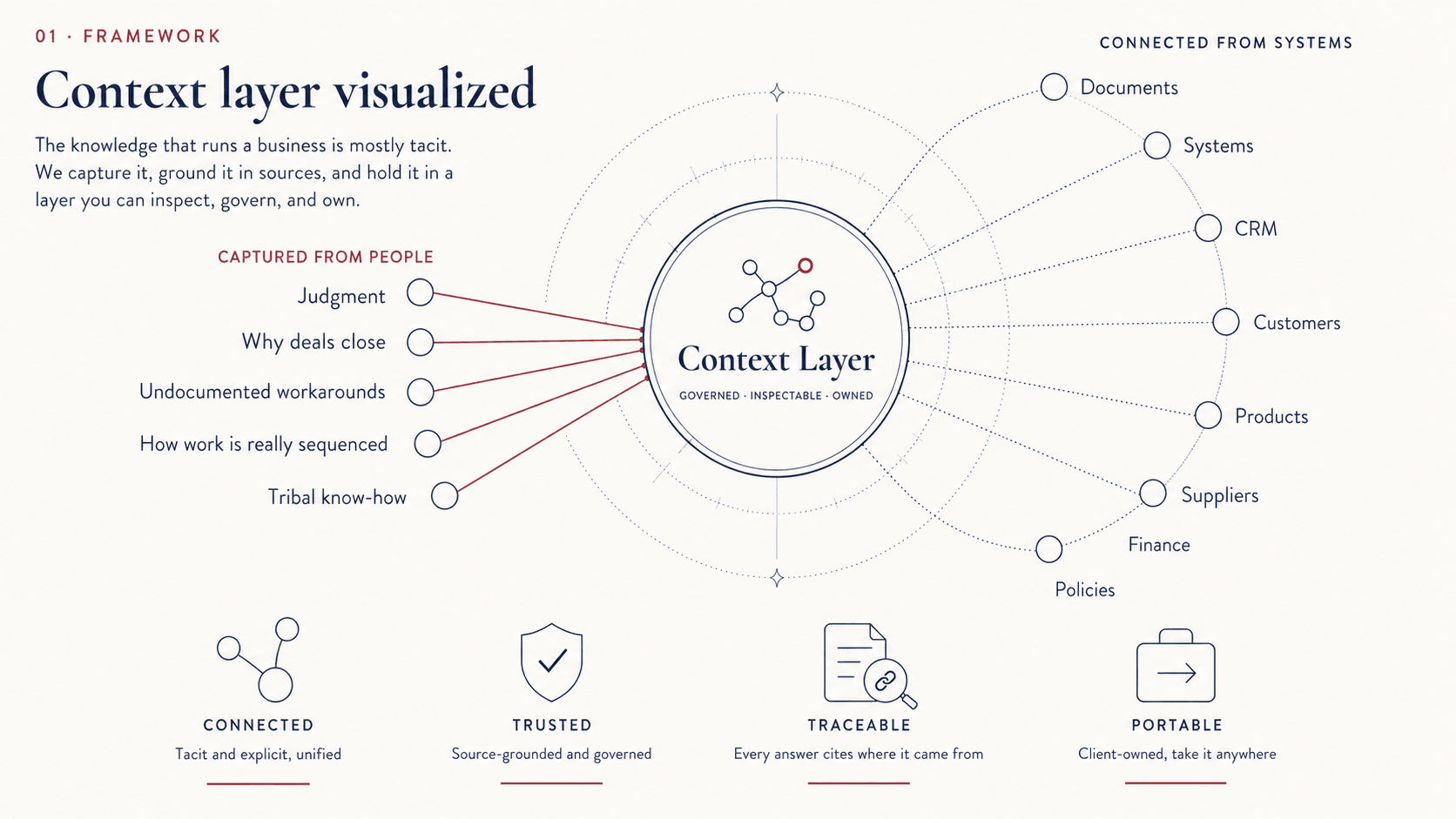
- Encoded knowledge base mapped to real workflows
- Authority rules: what information the system is allowed to trust
- Source-grounding so answers are auditable
- Encode a firm's deal-screening rubric so an agent can apply it consistently
- Capture a senior underwriter's review checklist before they retire
- Consolidate years of policy docs and email decisions into a citable knowledge source
B
Custom Apps & AI Agents
We build the apps and AI agents that do the legwork on real workflows, one function at a time, with humans kept in the loop where accountability matters.
- Takes repetitive research, synthesis, routing, and review off your team
- Takes one workflow live end to end before expanding further
- Keeps humans on the approval gates that carry risk
- Production apps and agents on your real workflows
- Clear human approval and exception handling
- Acceptance criteria and observable value per function
- Deal-memo synthesis drafted from a data room for human sign-off
- Inbound lead and email routing with an approval gate before anything sends
- Document review that flags exceptions instead of rubber-stamping them
C
AI Training & Enablement
We train your team to use AI, and the tools we build, effectively. This is organizational change management so adoption sticks, not another failed pilot.
- Builds real fluency, not a one-time demo
- Fits the people, permissions, and incentives already in the business
- Turns a launched tool into a used tool
- Role-based playbooks and a vetted prompt and tool library
- Hands-on workshops on your actual workflows
- An adoption plan with owners and checkpoints
- Onboard a team to the tools we build so usage survives past week two
- Stand up an internal prompt library matched to each role
- Run change management so the new workflow becomes the default
D
Build vs Buy Advisory
Woven through every capability: for each function, decide what to build custom, what to buy off the shelf, and what not to do at all. The fastest way to avoid tool sprawl and wasted budget.
- Stops you overbuying tools or overbuilding prototypes
- Gives a defensible call for every capability on the roadmap
- Can run standalone alongside a Sprint as a lighter step
- Capability-by-capability build, buy, or skip recommendation
- Vendor evaluation where buying wins
- A roadmap that spends effort only where it pays off
- Decide whether to license a vendor tool or build the workflow in-house
- Cut three overlapping pilots down to the one that matters
- Pressure-test a roadmap before committing engineering time
Non-negotiable
Acceptance tests, built into every module.
We build the tests that catch when your AI is confidently wrong. They run inside every Build and they are the core of what Operate maintains. Most consultants skip this. We do not.
What that means in practice
- A bank of known-correct examples each workflow is retested against
- Source-grounding checks so outputs trace back to authority
- Human accountability built into the loop from day one
- Tests that gate a module before it goes live
How they combine
Why the Context Layer comes first.
The capabilities are not a menu you pick from at random — they stack. Context is the foundation, one workflow proves the value, then modules compound on top, and Operate keeps the whole system maintained.
Encode the knowledge
Stand up the Context Layer so everything downstream has something solid to stand on.
Take one function live
Build one real workflow end to end, with acceptance tests, before expanding.
Add modules over time
Operate keeps the whole system maintained and compounding.
Capabilities are what we build. For how an engagement is structured and priced, see Services.
Next step
Not sure which capability you need?
That is what the Sprint is for. We map where AI creates real leverage and scope the first build.